
Blog
Universal Article/Blog/News module
global pollution and environmental status Jan 2026
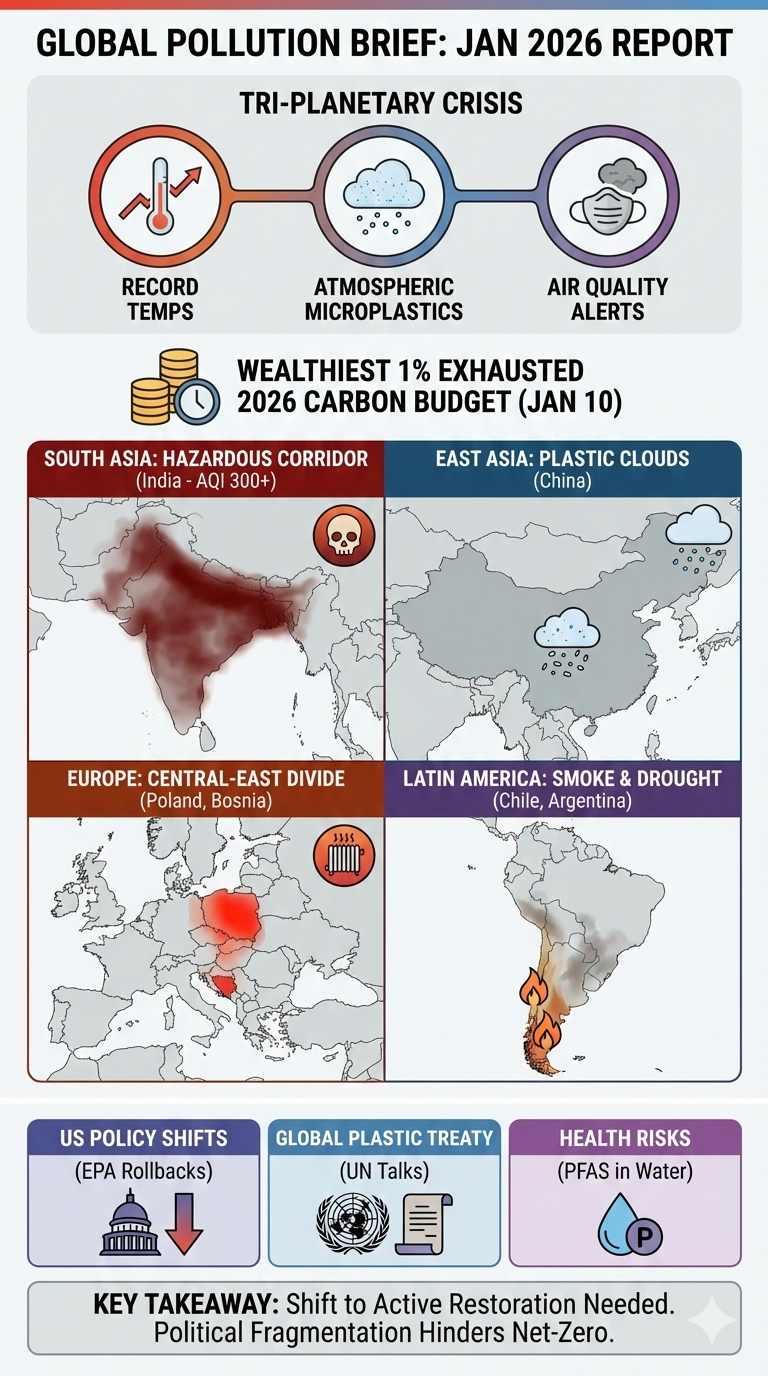
Global Executive Summary
The start of 2026 is marked by a "tri-planetary crisis": record-high winter temperatures, a surge in atmospheric microplastics, and severe air quality alerts across the Northern Hemisphere. A major Oxfam study released this month revealed that the wealthiest 1% of the global population exhausted their entire 2026 carbon budget in the first 10 days of January.
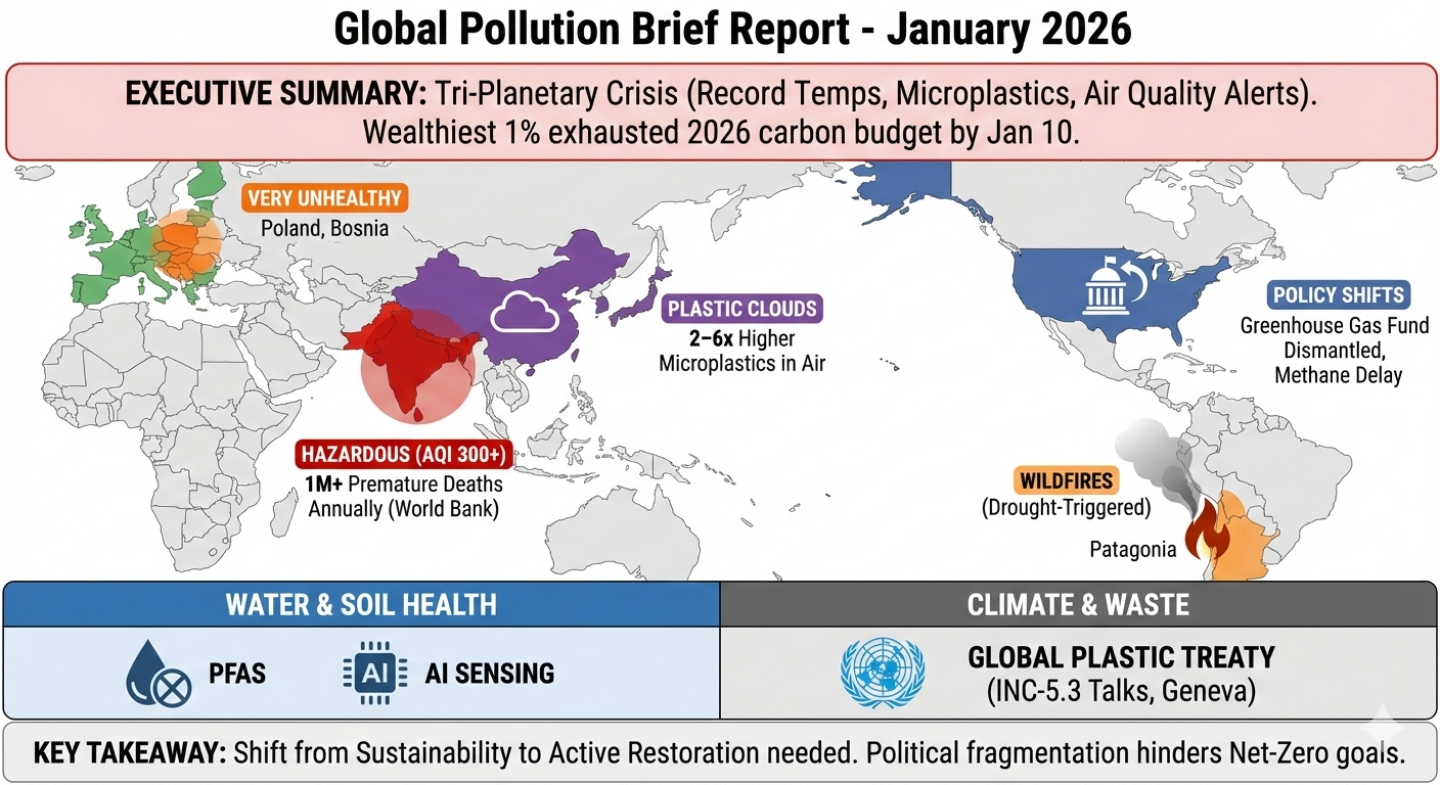
Air Quality: Hotspots & Hazards
1. South Asia: The "Hazardous" Corridor
The Indo-Gangetic Plains remain the world's most polluted region this month.
- The World Bank Report: A Jan 2026 report titled "A Breath of Change" estimates that 1 million premature deaths occur annually in this region due to persistent smog.
- Current AQI: Cities like New Delhi, Gorakhpur, and Rohtak (India) are consistently hitting "Hazardous" levels (AQI 300+), driven by winter temperature inversions and industrial emissions.
2. East Asia: The Discovery of "Plastic Clouds"
- New Research: Scientists at the Chinese Academy of Sciences (Jan 7, 2026) published findings that microplastic levels in the air over Guangzhou and Xi’an are 2–6 times higher than previously estimated.
- Atmospheric Impact: These "plastic clouds" are now being studied for their role in altering cloud formation and weather patterns over megacities.
3. Europe: The Central-East Divide
While Western Europe maintains "Good" to "Moderate" air, Central and Eastern Europe are struggling with winter heating emissions.
- Worst Performers: Poland (Rabka-Zdrój) and Bosnia (Kakanj) recorded "Very Unhealthy" air (AQI 230+) this week.
- Ozone Concerns: The Copernicus Atmosphere Monitoring Service (CAMS) warns of rising ground-level ozone levels even in mid-winter due to unseasonably warm temperatures.
Climate & Waste: Early 2026 Trends
Latin America: Smoke and Drought
- Wildfire Surge: Severe drought in Chile and Argentina has triggered massive wildfires early this year. Over 50,000 hectares have burned in Argentina's Patagonia, with smoke plumes significantly degrading air quality as far as the Atlantic coast.
United States: Policy Shifts
- Regulatory Rollbacks: The new U.S. administration has begun dismantling the $27 billion Greenhouse Gas Reduction Fund.
- Methane Delay: Federal requirements for methane reduction have been pushed back, leading to concerns from the EPA about a spike in localized industrial pollution near oil and gas sites.
Global Plastic Treaty (UN)
- Upcoming Talks: Negotiators are preparing for the INC-5.3 session in Geneva (Feb 7, 2026). The goal is to finalize a legally binding treaty to end plastic pollution, though consensus remains elusive regarding production caps.
Water & Soil Health
- PFAS "Forever Chemicals": Water monitoring in 2026 has shifted toward AI-driven sensing. New European regulations have identified PFAS in several major groundwater basins previously thought to be safe.
- Africa: The Africa CDC issued a report on Jan 8, 2026, linking contaminated water sources in rural western and northern parishes of Jamaica and parts of Morocco to rising public health risks following extreme weather events.

The world is moving from "sustainability" to "active restoration" as a necessity. While technology (AI-driven sensors) is providing more accurate data than ever, political fragmentation and extreme weather events (wildfires/heatwaves) are complicating the path to net-zero.
***global pollution and environmental status report for January 19, 2026, synthesized from recent data by the World Bank, Copernicus, and regional environmental agencies.
Tags: